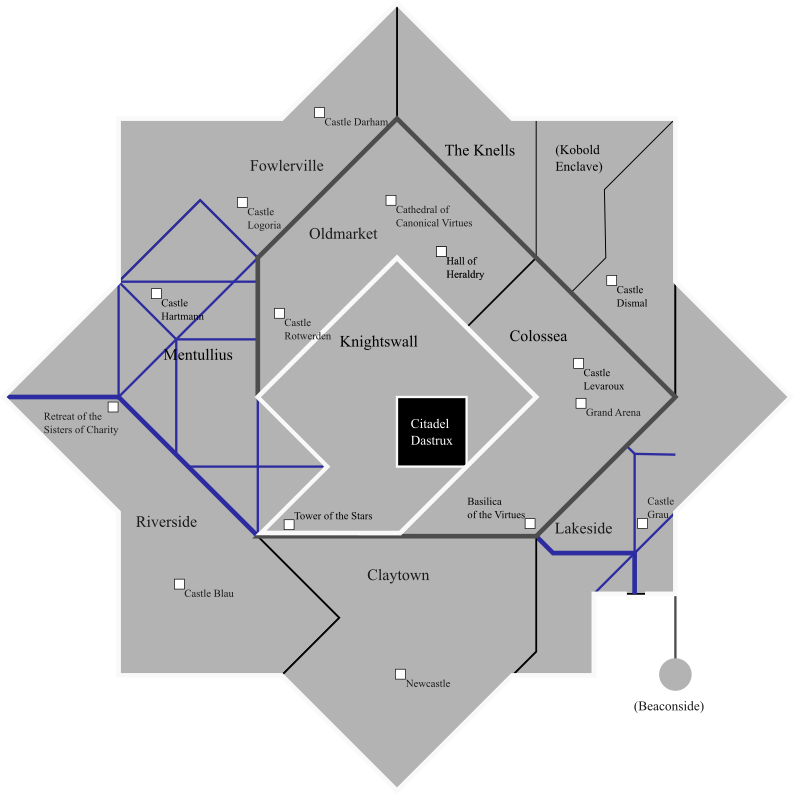
Around the City
Dastrux City is a centrally-planned masterpiece, and an architectural cohesion prevails across the city, though all districts diverge a bit from this ideal.
Buildings are made of stone on the ground floor and half-timber construction above, with either white stucco or whitewashed planks. The stones are irregular, but rectangular, providing a flat but not smooth surface. Roofs are shingled in tiles of blue stone and pitched shallowly in saltbox fashion; the higher side faces the street, and the longer side gathers rainwater into a cistern behind the building.
Lots are narrow but deep, and buildings are wall to wall, creating a courtyard within each block. Each building’s lot within the courtyard is fenced off and usually holds any two of a vegetable garden, a chicken coop, a dairy goat, and a pair of hogs. Sewage gathers in cesspools in each courtyard, and either drains into the ruins beneath the city or is sold to nightsoil men.
Gold is the color of the Imperial Family, and no one outside the Kaiser’s immediate service is allowed to fly a banner or flag of, or dress in, plain yellow; yellow embattled with chiefs of different colors are granted as rewards for different types of service. Aside from this restriction, buildings are decorated with cloth banners, some even crossing the road. People likewise dress in bright colors, or colors that have faded from once bright.
Musicians are a common sight on street corners in every district. Town criers regularly appear in the same locations.
The law is kept by the Constabulary in most of the city; they wear blue slashed clothes with silver breastplates and caps. Their duties are to keep the peace and enforce any judgments by the courts. Investigative policing is done by agents of the courts, identified by the gold and blue feathers in their caps and usually armed with cudgels and leather or brigandine armor. The Palatine Guard are the law in Knightswall and overlap with the Constabulary in Oldmarket and Colossea (and, at order, anywhere that pleases the Kaiser). They dress all in gold, wear plate armor, and carry a ranseur, an arming sword, and a musket.
Major Landmarks
- Castle Blau, named for the tint of its stucco. Held by House Sievert.
- Castle Darham, with its iron gates. Not leased to any house.
- Castle Dismal, the city prison. Castle Dismal alone is never entrusted to a family; it is currently operated by Castellan Rupert Altelt.
- Castle Grau, named by the unimaginative. Held by House Orlun.
- Castle Hartmann, which bears an extra circuit of walls. Held by House Morling.
- Castle Levaroux, with its carved stag’s head above the gate. Not leased to any house.
- Castle Logoria, with its twin keeps. Held by House Gyges.
- Newcastle, built in ‘83. Held by House Tatius.
- Castle Rotwerden, which catches the evening sun. Held by House Althann.
- The Basilica of the Virtues, the original small temple of the humanist religion.
- The construction site of the Cathedral of Canonical Virtues, a vast foundation and scaffolding. By funding and dedicating the Cathedral, the Kaiser hopes to bring the Virtue conventicles under Crown auspices, but funding has slowed to a trickle because of the war.
- The Grand Arena, where melees and tourneys are held.
- The Hall of Heraldry, which holds both legal and legendary records of the city’s noble families. A newly-blooded individual who registers here is sure to attract attention.
- The Retreat of the Sisters of Charity, a walled monastery that serves as the nuns’ headquarters.
- The Tower of the Stars, an observatory. Its campus is terraced and gardened, with marble libraries and halls of learning; its tower is taller than any point in the city except for Citadel Dastrux.
A District Map